How AI could change the business of running senior living dining

The most interesting artificial intelligence story in senior living right now is not happening in the care plan. It is happening in the back of the kitchen.

It reveals itself in how a community buys food, how much it prepares for a given meal, how much of that food ends up in the trash, how it staffs a dining room across a demand curve that never stays flat, and whether anyone actually knows what residents want before a quarterly survey gets around to asking.

Almost none of the AI conversation in this industry, which tends to gravitate toward falls detection, remote monitoring, and documentation tools that free up a few hours of nursing time, touches any of that.

Read the full article here

Today’s senior living residents want variety, choice, and control when it comes to dining

Senior living residents increasingly demand variety, choice, and multi-concept dining options. Restaura Founder and Executive Chairman Richard Schenkel explains how the industry must adapt going forward.

The residents entering senior living communities today are not like the residents of yesterday, and senior living dining programs are racing to keep up with meeting their needs.

“All of it is kind of so changing so quickly, and part of that is really due to the change in the type of resident that’s entering into a facility,” says Richard Schenkel, Founder and Executive Chairman of Restaura, a senior living foodservice provider.

Today’s residents are looking for far more variety than their predecessors. They’re also taking a community’s dining program into heavier consideration when making their decision on where they want to live.

Read the full article here

The Real Product Every Dining Program Sells Isn’t Food. It’s Confidence.

A student doesn’t transfer because the pasta was overcooked once.

A resident’s family doesn’t pull them off a waitlist because of one bad dinner review.

A patient doesn’t choose a different hospital system because a tray arrived cold.

They leave, or never arrive, because somewhere along the way, they stopped trusting that the standard would hold. One bad meal is an incident. A pattern of bad meals, inconsistent service, or unaddressed complaints is something else entirely: a slow leak of confidence. And once confidence goes, it rarely comes back through an apology. It comes back through proof.

This is the thread connecting every sector we work in.

Higher education, senior living, healthcare, corporate dining, all with different populations, different regulators, different stakes. But strip away the context and the failure mode is identical: an institution assumes its dining program is delivering on its promises, while the people eating there quietly decide whether to believe it.

The data says the gap is real. And it’s public

In higher ed, dining is no longer a soft amenity. It’s a searchable, published grade. Niche scores over 1,000 institutions annually on food quality, drawing on nearly 500,000 student reviews. A “C,” “D,” or “F” doesn’t stay internal; it sits next to safety scores and academic rankings for every prospective family to see. And the confidence gap shows up starkly in the numbers: only about 1 in 4 students say their college is “getting dining options right.” Just 15% are enthusiastic about their wellness and dining offerings. Meanwhile, 54% of students say dining directly influenced whether they stayed enrolled.

In senior living, the same pattern shows up in different language. J.D. Power found dining drove one of the largest satisfaction swings of any category, up 11 points one year, dragging independent living scores down the next when performance slipped. 39% of prospective residents name high-end dining as a key factor in choosing a community, and adult children – the ones actually making the placement decision for a parent – treat the dining room as a proxy for the quality of care happening everywhere else in the building.

Healthcare and corporate dining tell the same story with different vocabulary: patient satisfaction scores, employee engagement surveys, retention metrics. The mechanism doesn’t change. Confidence is built meal by meal, and lost the same way.

Why the gap exists. And why it’s structural, not a failure of effort

None of this happens because operators don’t care. Culinary directors get hired. Brand standards get written. Beautiful dining rooms get built. The gap opens anyway, because:

  • Managers can’t be everywhere, every shift, every service period.
  • Contract partners have their own priorities, and self-reporting has an inherent conflict of interest.
  • Staff turnover means institutional knowledge is constantly being rebuilt from scratch.
  • Problems surface in satisfaction surveys or public reviews — which is the worst possible place to find out, because by then the confidence is already gone and the review is already permanent.

Internal reporting is valuable. It is also, by definition, not independent. An institution grading its own homework is not the same as a family, a prospective student, or a resident’s adult child deciding whether to trust what they’ve been told.

Confidence has to be demonstrated, not asserted

This is the case for independent quality assurance, not as an audit that produces a binder nobody reads, but as an ongoing, objective measurement system that catches drift before it becomes a review, a transfer, or an empty bed.

This is exactly the gap CrossCheck was built to close. By pairing a configurable QA intelligence platform with trained, independent, on-site evaluators, CrossCheck gives leadership something internal surveys and vendor self-reporting can’t: an unbiased, continuous read on whether the experience being delivered actually matches the standard being promised. Not a verdict but a catalyst. Data that tells a team what to fix, why it matters, and how to prove it’s fixed.

Whether the population is 18-year-old students choosing a school, 80-year-old residents choosing a community, patients choosing where to return for care, or employees deciding whether to stay, the underlying question is the same one leadership should be asking itself:

If someone challenged our dining program’s reputation today, could we prove, independently, objectively, that it’s earned?

If the honest answer is “we assume so,” that’s the gap worth closing.


Eric Healy is the CEO of CrossCheck Quality Assurance. CrossCheck partners with organizations across higher education, senior living, healthcare, and corporate dining to provide independent, on-site quality assurance.

Your RTO Strategy Isn’t Failing. Your Midday Experience Is

Every return-to-office strategy faces a competitor that didn’t meaningfully exist five years ago: a comfortable home office with no commute and greater flexibility. Today, most employees aren’t comparing your office to another office; they’re comparing it to home. 

The workplace experience has become just as important as the work itself. Yet many organizations continue to approach return-to-office primarily as a policy challenge rather than an experience challenge. Conversations about attendance requirements, flexibility guidelines, and manager discretion matter, but they only go so far. Because when employees come into the office, they’re really making a value calculation: Is the experience worth the trip? 

 The Untapped Power of Midday 

What I’ve come to believe is that one of the biggest opportunities in return-to-office isn’t found in policy; instead, it’s found in the middle of the day. The stretch between late morning and early afternoon has an outsized impact on how employees feel about being onsite. It’s where relationships are built, energy is restored, and ideas are exchanged.  

Yet in many organizations, the middle of the day is left to chance. People scatter, eat alone, or leave the office altogether. The result is a workplace that functions efficiently but fails to create connections. For all the attention paid to office design and return-to-office policies, too little is devoted to the experiences that make being onsite worthwhile. 

JLL’s 2025 Workforce Preference Barometer found that nearly 40% of employees believe their workplace experience needs improvement. In other words, many employees are telling employers that the office has not yet earned the commute. Food and beverage experiences consistently rank among the most valued workplace offerings. Not because employees are looking for free lunches, but because they’re looking for reasons to believe the office offers something they can’t get at home. 

 Facilities managers and HR leaders are quickly recognizing that a thoughtfully designed midday experience can influence dwell time, collaboration, and workplace satisfaction. The goal isn’t simply feeding people, it’s creating moments of connection, convenience, routine, and belonging. 

Designing Reasons to Stay 

One downtown Chicago office tower we work with offers a good example. An underutilized café was transformed into a hospitality-driven gathering space featuring chef-created menu experiences, culinary showcases, wine programming, and community activations. The objective wasn’t foodservice; it was to create a destination inside the building that encouraged employees to stay, interact, and engage during the middle of the day. The results were telling. What began as a dining venue became a social hub. 

We’ve seen similar outcomes through recurring tenant experiences such as seasonal tasting events, Mardi Gras celebrations, summer barbecue pop-ups, trivia competitions, karaoke events, and sports-themed activations. Attendance quickly became a catalyst for interaction among employees who otherwise may never have connected. 

Importantly, these experiences create something many organizations desperately need: opportunities for human interaction that aren’t tied to another meeting invitation. 

Convenience matters as well. We’ve partnered with clients to redesign traditional grab-and-go programs to function more like curated retail experiences. The differences include better product quality, all-day availability, and more engaging merchandising. The result? Increased participation and reduced number of employees leaving the building during the workday. 

The lessons weren’t only about food; they were about friction. People are more likely to remain engaged when the workplace makes their day easier, not harder. 

 We’re also seeing organizations use hospitality programming to activate slower building occupancy days. Book clubs, local business partnerships, seasonal events, chef demonstrations, and community gatherings provide additional reasons for employees to choose the office when attendance might otherwise lag. 

The ROI of Connection 

Almost every company is already investing heavily in talent acquisition, retention, office space, technology, and culture-building initiatives. Hospitality experiences help unlock greater value from those investments by creating more opportunities for employees to connect, collaborate, and engage with the workplace. That’s why the return on investment shows up in a Café P&L, as well as increased space utilization and improved tenant and employee satisfaction. 

The most effective leaders understand that workplace culture is rarely built through policy alone. It’s built through experiences, a shared meal, a spontaneous discussion, and a celebration that breaks up the routine. The moments employees remember are often the ones that never appear on their calendar. 

That’s why return-to-office discussions need to evolve. The question is no longer how to get employees back into the office; it’s what kind of experience awaits them when they arrive. 

Home has become a legitimate competitor in the workplace. Organizations that acknowledge that reality and intentionally design experiences that foster connection, energy, and belonging will have an advantage over those that continue relying primarily on policy. 

Marc Hinson is Chief People Officer at Phoenix3 Collective and Infuse Hospitality, which provides corporate dining and hospitality management services. He has more than three decades of experience building people-first cultures across the hospitality, restaurant, and real estate industries, including some of the country’s most recognized multi-concept restaurant brands.

Boston to Lead Longevity Economy

Boston’s Next Growth Engine Won’t Be Another Lab. It Will Be Aging. 


Phoenix3 Collective Founder and CEO Richard Schenkel is featured in the Boston Business Journal with his perspective on why aging may become Greater Boston’s next major economic growth engine. Drawing parallels to the rise of Kendall Square, Schenkel argues that the region has a unique opportunity to lead the emerging longevity economy by aligning innovation, investment, workforce development, and healthy aging initiatives.

Read the full article from Boston Business Journal here

ICAA awards the first-ever Platinum Plate of Distinction to The Mather at Tyson’s

The Mather at Tysons, a continuing care retirement / life plan community in northern Virginia, has been awarded the first-ever Platinum Plate of Distinction in North America from the International Council on Active Aging. The distinction recognizes the community’s excellence in culinary, nutrition, hospitality and innovation in senior living.

Read the full article here

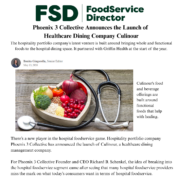
Phoenix3 Collective announces the launch of healthcare dining company Culinour

There’s a new player in the hospital foodservice game. Hospitality portfolio company, Phoenix3 Collective has announced the launch of Culinour, a healthcare dining management company. 

Read the full article here

Industry Insights with Infuse Hospitality

Breaking into foodservice procurement is competitive. And once you’re in, growing your footprint and managing channel conflicts only gets more complex.  

Becoming an approved supplier and expanding categories with the right partners can unlock significant, sustainable revenue for your business, but the “how” can be tricky to ascertain. 

Infuse Hospitality is thrilled to join the SHFM Industry Advisory Board’s virtual supplier series for an exclusive session with our leadership team: CEO Paul Fairhead and SVP of Supply Chain and Services Randy Dominguez. 

 Learn directly from us how to: 

  • Become an approved supplier 
  • Expand your categories 
  • Navigate channel conflicts 
  • Stand out as a strategic partner 

This is a rare opportunity to hear firsthand what we look for in supplier relationships and how you can position your company for long-term growth with Infuse. 

 Register here for the SHFM’s Industry Insights with Infuse Hospitality webinar June 12th 1 PM EST! 

Listening First: A Senior Living Dining Turnaround

On Harry Guerra’s first day as food and beverage director of The Seabrook at Hilton Head last summer, he got an earful.

Read More at FoodService Director

Accountability Will Define the Next Decade of Senior Living Dining

For decades, senior living executives have treated dining much like other amenities such as fitness or activities —  important to daily life but not consistently measured. Operators relied on intuition, occasional feedback and the belief that great culinary service was more art than science. However, as senior living communities evolve and residents and their families bring higher expectations to the table, good intentions are no longer enough.  

Read full post on Seniors Housing Business